
Without Building a Sales Team
Build a Predictable Revenue Engine.
Without the Hiring, Overhead, or Risk.
How to Grow Sales
In This Growth Blueprint, You'll Learn
Most founders assume that growing revenue requires hiring salespeople.
In reality, many companies build expensive sales teams long before they build a repeatable sales system.
The result is predictable: rising payroll costs, inconsistent pipeline generation, missed revenue targets, and founders becoming more involved in sales rather than less.
The companies that scale successfully take a different approach.
Before adding headcount, they build a revenue engine.
They identify the right customers, develop a repeatable go-to-market strategy, diversify acquisition channels, create a structured sales process, and establish predictable methods for converting opportunities into revenue.
Table of Contents
Why Most Companies Struggle to Scale Sales
How Do You Know If You Really Need a Sales Team?
How Long Does a Sales Team Take to Generate ROI?
What Is the Right Mix of Inbound, Outbound, and Partnership Sales?
Can You Grow Sales Without Building a Sales Team?
How Do You Know If Sales Outsourcing Will Work for Your Business?
Lead Generation vs End-to-End Sales Outsourcing
Why GroRev SalesNair Focuses on Revenue, Not Just Meetings
Can Sales Outsourcing Help You Build an Internal Sales Team Later?
Conclusion: Choosing the Right Growth Model for Predictable Revenue Growth
Most importantly, you'll discover why the fastest path to predictable revenue growth is often not hiring more salespeople—it's building a revenue system that consistently acquires customers.
Whether you're a founder-led startup, a SaaS company, an IT services firm, a consulting business, or a growing B2B organization, this blueprint will help you evaluate the most efficient path to scaling sales while minimizing risk, cost, and management overhead.
Why Most Companies Struggle to Scale Sales
For many founders, sales is the single biggest growth constraint.
The challenge is not finding a salesperson. The challenge is building a revenue engine that consistently generates opportunities, converts prospects into customers, and creates predictable growth.
Unfortunately, most companies approach sales growth by immediately hiring salespeople. They assume that more salespeople automatically lead to more sales.
In reality, salespeople do not create revenue systems.
They operate within revenue systems.
Without the right market positioning, sales process, outreach strategy, messaging, technology, and management structure, adding more salespeople often creates additional costs rather than additional revenue.
This raises an important question:
Can a company grow sales without building an internal sales team?
The answer is yes.
But before deciding whether to hire, outsource, or build internally, founders need to understand how sales organizations actually generate return on investment.
How Do You Know If You Really Need a Sales Team?
One of the most expensive mistakes founders make is hiring salespeople before validating whether a dedicated sales organization is actually required.
A sales team becomes necessary when sales success is no longer dependent on the founder's personal relationships, reputation, or direct involvement.
If most new customers come through referrals, founder networking, repeat business, or inbound enquiries, a company may not need a large sales team yet.
Instead, it may need:
Better lead generation
Better follow-up processes
Stronger positioning
Improved conversion systems
A useful test is to ask a simple question:
Can someone other than the founder consistently sell the company's services?
If the answer is no, the problem is usually not the absence of a sales team.
The problem is that the sales process has not yet been documented and standardized.
Many founders attempt to solve a process problem with a hiring decision.
As a result, they hire SDRs, Account Executives, or Business Development Managers who struggle because the company lacks:
A defined Ideal Customer Profile (ICP)
Consistent messaging
Proven sales conversations
Objection handling frameworks
Clear qualification criteria
A repeatable sales process
The result is predictable.
The founder becomes the sales manager, trainer, marketer, CRM administrator, proposal writer, and closer.
Instead of gaining leverage, they become even more involved in sales.
Before hiring salespeople, founders should first evaluate whether they have a repeatable customer acquisition model.
If customer acquisition is already predictable and the challenge is capacity, hiring makes sense.
If customer acquisition is still inconsistent, building additional headcount often magnifies existing problems.
This is why many successful startups first focus on creating a repeatable revenue engine before investing heavily in internal sales teams.
The objective should never be hiring salespeople.
The objective should be creating predictable revenue.
How Long Does a Sales Team Take to Generate ROI?
Most founders significantly underestimate the time and investment required to make a sales team productive.
Hiring is only the first step.
After recruitment comes onboarding, training, process adoption, messaging refinement, pipeline creation, and performance management.
Even experienced salespeople require time to understand:
The market
The buyer
The product
The competitive landscape
The sales process
For most B2B businesses, the timeline looks something like this:
Month 1–2
Training, onboarding, CRM setup, learning the offering.
Month 2–4
Prospecting begins and initial meetings are generated.
Month 4–6
Pipeline starts forming.
Month 6–9
First meaningful sales results begin appearing.
Month 9–12
The sales representative reaches full productivity.
This assumes the company already has:
Strong positioning
Proven messaging
Existing sales assets
Defined processes
Active management
If these foundations are missing, the timeline becomes even longer.
Many startups hire a salesperson expecting immediate revenue.
Instead, they spend six months paying salaries while simultaneously trying to figure out the sales process.
The financial reality is often overlooked.
The true cost of a salesperson includes:
Salary
Incentives
Recruitment costs
Sales tools
CRM systems
Training
Management time
Lead generation costs
A ₹10 lakh annual salesperson can easily become a ₹15–18 lakh annual investment when all supporting costs are considered.
This does not mean founders should avoid hiring.
It simply means hiring should occur after the revenue engine has been designed.
The faster path for many companies is often to validate the sales model first and build the internal team later.
This approach reduces risk, accelerates learning, and creates a much clearer path to ROI.
What Is the Right Mix of Inbound, Outbound, and Partnership Sales?
There is no single sales channel that consistently drives growth.
The highest-performing B2B companies rarely depend on one acquisition source.
Instead, they combine multiple channels into a unified revenue engine.
A balanced growth model typically includes three core components.
Inbound Sales
Inbound creates awareness and captures demand.
Examples include:
SEO
Content marketing
LinkedIn thought leadership
Webinars
Referrals
Paid campaigns
Inbound works extremely well for building credibility and generating interest.
However, inbound alone often creates unpredictable lead volume.
Most founders discover that waiting for prospects to find them limits growth.
Outbound Sales
Outbound creates demand rather than waiting for it.
Examples include:
Email outreach
LinkedIn prospecting
Cold calling
Account-based sales campaigns
Outbound provides greater control over pipeline generation because the company actively targets specific accounts.
For startups, outbound is often the fastest way to validate markets and acquire initial customers.
Partnership Sales
Partnerships create leverage.
Examples include:
Technology partners
Referral partners
Consulting firms
Agencies
Industry associations
Partnership channels frequently produce higher-quality opportunities because trust already exists between the partner and the prospect.
The most effective revenue engines combine all three channels.
Inbound builds credibility.
Outbound generates opportunities.
Partnerships accelerate trust.
The exact mix varies by industry, but founders should avoid becoming dependent on any single channel.
If one channel slows down, growth should continue through the others.
The goal is not lead generation.
The goal is pipeline diversification.
Companies that build multiple acquisition channels create far more predictable growth than companies relying on referrals or founder relationships alone.
Can I Grow Sales Without Building a Sales Team?
The short answer is yes.
In fact, many companies scale revenue long before building a large internal sales organization.
This is where sales outsourcing becomes an attractive option.
Sales outsourcing is often misunderstood as simply hiring an external appointment-setting agency.
True sales outsourcing is much broader.
It involves building and operating the entire revenue engine on behalf of the client.
This can include:
Market research
ICP development
Prospect database creation
Outbound campaigns
LinkedIn outreach
SDR execution
Discovery calls
Opportunity management
Proposal development
Sales process optimization
Revenue forecasting
Deal closure support
For founders, the biggest advantage is speed.
Instead of spending six to twelve months recruiting and building an internal team, they gain access to a proven revenue infrastructure immediately.
The founder can continue focusing on:
Product development
Customer success
Operations
Strategic growth
While the outsourced team manages pipeline generation and revenue execution.
This model is particularly effective for:
B2B service providers
SaaS companies
IT consulting firms
Cybersecurity firms
Compliance organizations
Technology startups
The objective is not replacing the founder.
The objective is reducing founder dependency.
Companies such as GroRev SalesNair operate as an extension of the client's organization, supporting everything from pipeline creation to revenue growth initiatives.
For many startups, this approach creates faster results and lower risk compared to building a sales department from scratch.
How Do You Know If Sales Outsourcing Will Work for Your Business?
A common misconception is that sales outsourcing only works for specific industries.
The reality is that it works exceptionally well for most B2B organizations.
The strongest indicators that sales outsourcing can succeed include:
High-value transactions
Consultative sales processes
Long buying cycles
Founder-led selling
Limited internal sales expertise
Ambitious growth targets
If the founder is currently responsible for sales, there is usually significant opportunity to create leverage.
The key question is not whether sales outsourcing works.
The key question is whether the company has a market that can be reached through structured sales activities.
If customers can be identified, contacted, qualified, and moved through a sales process, outsourcing can be highly effective.
Technology startups are particularly strong candidates.
Many founders excel at building products but struggle to create predictable customer acquisition systems.
Sales outsourcing allows them to focus on innovation while experienced revenue professionals manage prospecting, qualification, and pipeline development.
The best sales outsourcing engagements are not vendor relationships.
They are strategic partnerships.
The outsourcing provider becomes accountable for creating measurable business outcomes rather than simply delivering activity metrics.
This is one reason many growth-stage companies use outsourced sales teams before investing heavily in internal hiring.
It allows them to validate markets, messaging, and acquisition strategies before committing to permanent headcount.
What Is Better for a Tech Startup: Lead Generation or End-to-End Sales Outsourcing?
Many founders begin their growth journey by hiring a lead generation agency.
The promise is simple.
"We will book meetings for your sales team."
While this sounds attractive, it often creates a new problem.
The founder still becomes responsible for everything that happens after the meeting is booked.
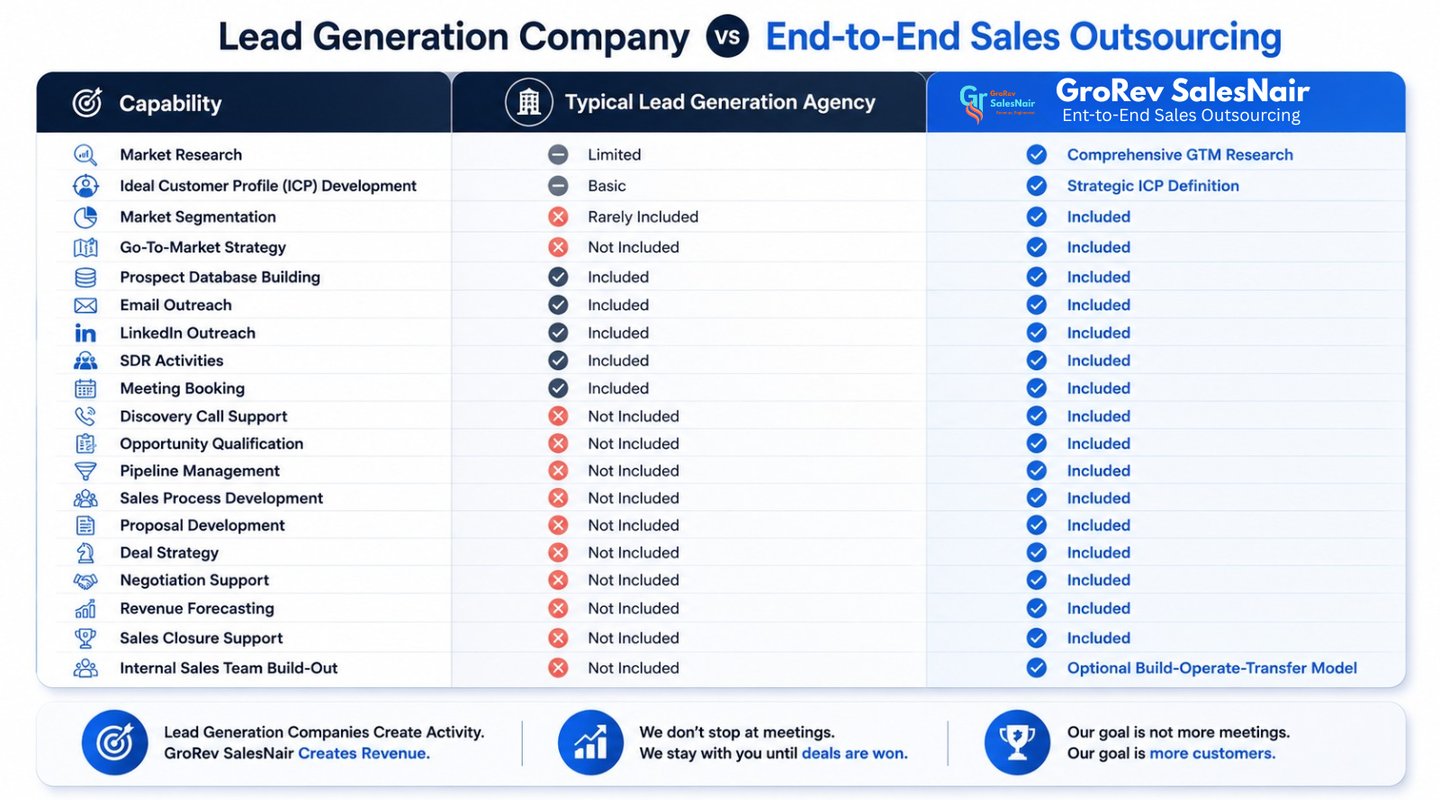
Most lead generation companies focus on a very narrow portion of the sales process:
Building prospect lists
Sending emails
LinkedIn outreach
Appointment setting
Once a meeting is booked, their responsibility typically ends.
The founder or internal team must then handle:
Discovery calls
Qualification
Sales presentations
Proposal creation
Follow-up
Objection handling
Negotiation
Closing
This approach works well if a company already has a mature sales organization.
However, most startups do not have a mature sales organization.
They have a founder trying to manage product development, customer success, operations, fundraising, and sales simultaneously.
As a result, many of the meetings generated by lead generation agencies never convert into revenue because there is no structured sales process behind them.
The difference is significant.
A lead generation company helps create conversations.
An end-to-end sales outsourcing partner helps create revenue.
At GroRev SalesNair, we operate as an extension of your business rather than a meeting-generation vendor.
Our engagement typically begins long before the first outreach campaign is launched.
We help clients answer critical questions such as:
Who should we target?
Which industries should we prioritize?
What messaging resonates with decision-makers?
Which acquisition channels should we invest in?
What sales process will convert opportunities into customers?
What activities should be measured weekly?
What pipeline coverage is required to achieve revenue goals?
From there, we support the complete revenue journey:
Research → Positioning → Prospecting → Meetings → Qualification → Pipeline Development → Proposal Support → Revenue Growth
For technology startups, IT services firms, SaaS companies, compliance providers, and B2B consulting organizations, this approach often produces significantly better outcomes because it addresses the entire revenue engine rather than a single activity within it.
The reality is simple.
Meetings do not pay salaries.
Closed customers do.
If your goal is simply to increase activity, a lead generation agency may be sufficient.
If your goal is to build predictable revenue growth without hiring an entire sales department, end-to-end sales outsourcing provides a far more comprehensive solution.
This is why many founders engage GroRev SalesNair not as a lead generation vendor, but as their outsourced sales organization—bringing the strategy, process, execution, and revenue leadership required to move opportunities from prospect to paying customer.
The Real Question
The decision is not whether you need more leads.
The decision is whether you need more revenue.
If your business is looking to scale sales without the cost, complexity, and management overhead of building an internal sales team, schedule a Sales Outsourcing Consultation with GroRev SalesNair. We will assess your current sales maturity, identify growth bottlenecks, and determine whether an end-to-end sales outsourcing model can accelerate your path to predictable revenue growth.
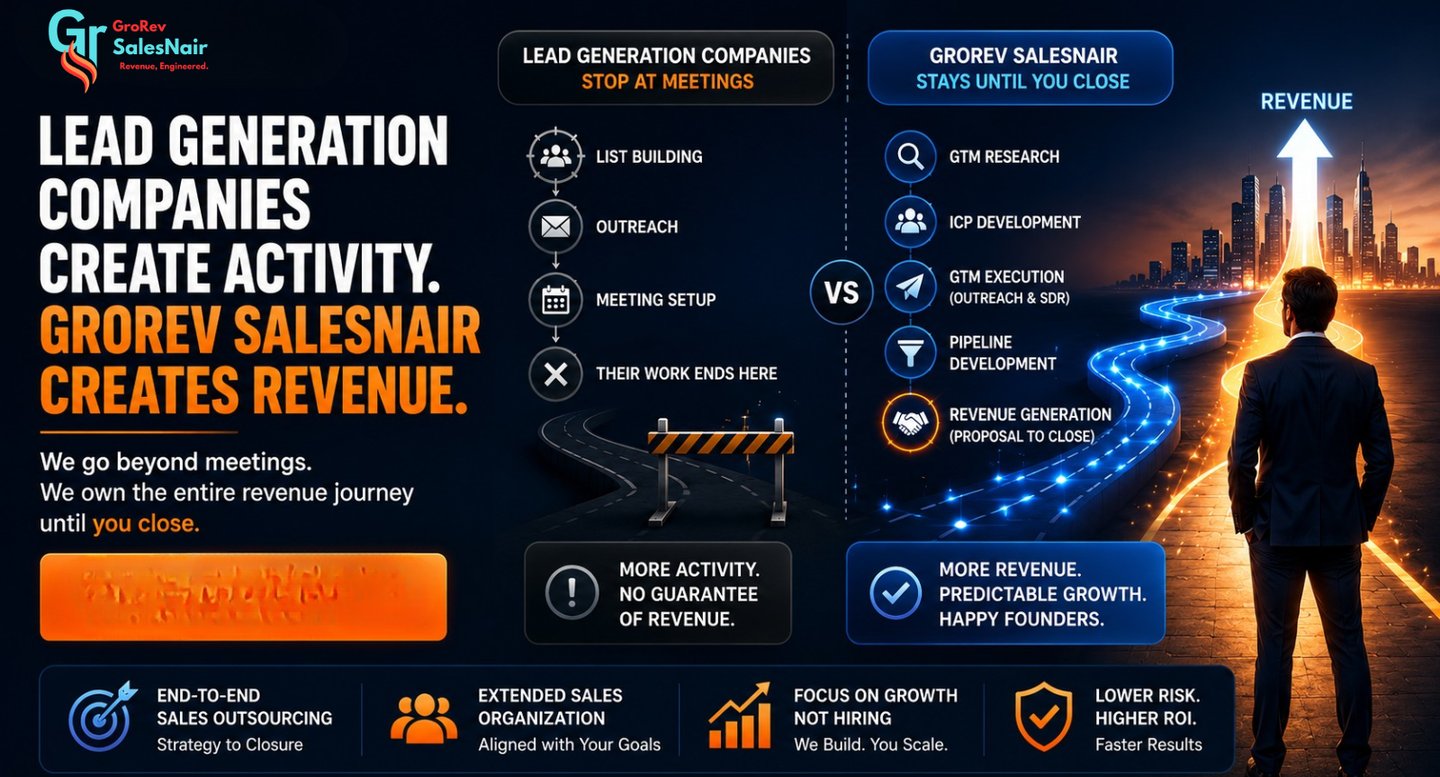
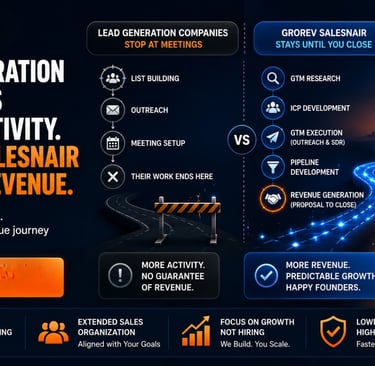
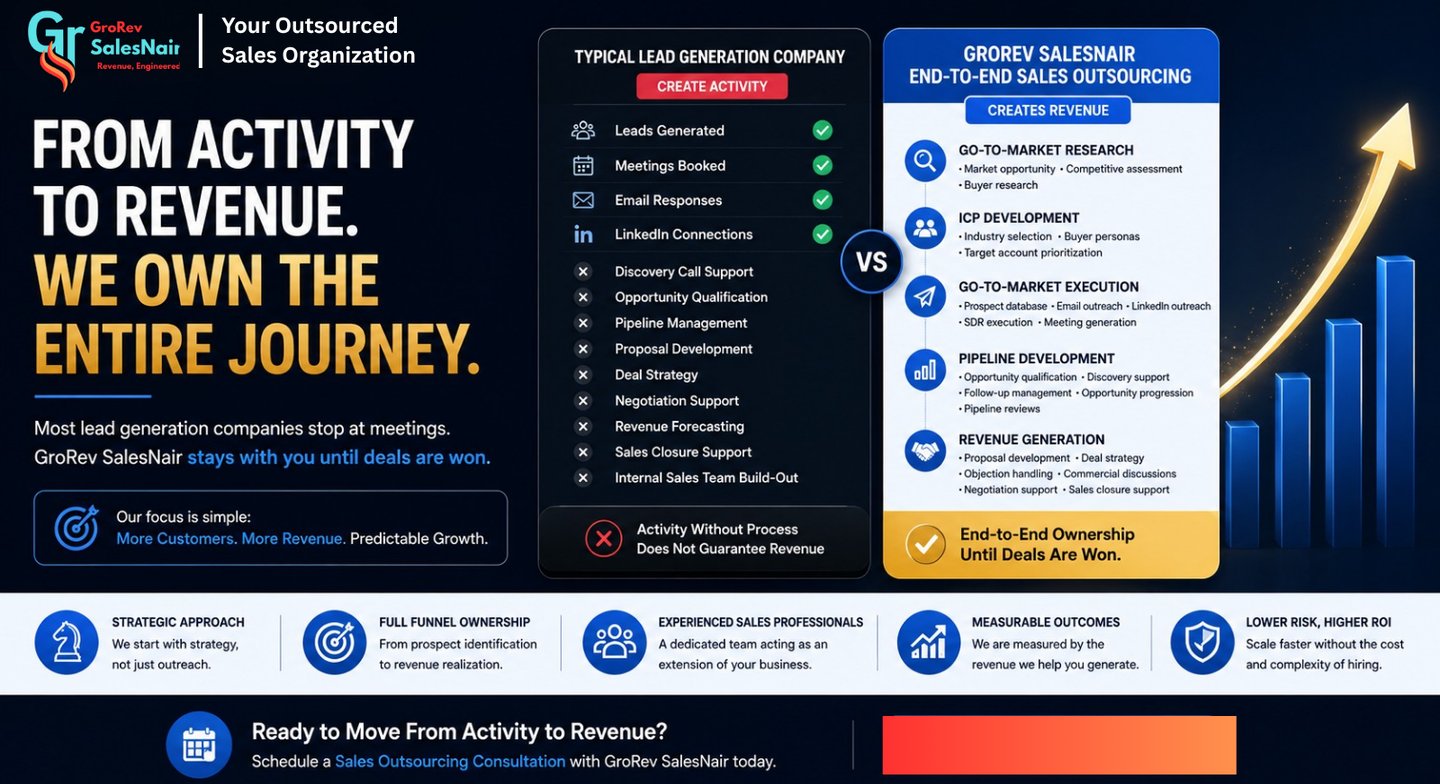
Lead Generation Companies Create Activity. GroRev SalesNair Creates Revenue.
Most lead generation agencies measure success using activity metrics:
Leads generated
Meetings booked
Email response rates
LinkedIn connections
While these metrics are important, they do not necessarily translate into revenue.
A founder can receive 30 meetings in a month and still close zero customers.
This happens because lead generation is only one stage of the sales process.
Revenue is created when opportunities move successfully through the entire customer acquisition journey.
At GroRev SalesNair, we believe businesses do not need more meetings.
They need more customers.
That is why our End-to-End Sales Outsourcing model supports every stage of the revenue cycle:
Go-To-Market Research
Market opportunity analysis
Competitive assessment
Buyer research
ICP Development
Industry selection
Buyer persona identification
Target account prioritization
Go-To-Market Execution
Prospect database creation
Email outreach
LinkedIn outreach
SDR execution
Meeting generation
Pipeline Development
Opportunity qualification
Discovery support
Follow-up management
Opportunity progression
Pipeline reviews
Revenue Generation
Proposal development
Deal strategy
Objection handling
Commercial discussions
Negotiation support
Sales closure support
Unlike traditional lead generation providers, GroRev SalesNair remains engaged throughout the entire sales cycle.
Our objective is not simply to generate opportunities.
Our objective is to help clients acquire customers and generate revenue.
A booked meeting has no value until it becomes a paying customer.
That is why GroRev SalesNair operates as an outsourced sales organization, helping founders move from prospect identification all the way to signed contracts and revenue realization.
Simply put:
Lead Generation Companies help you start conversations.
GroRev SalesNair helps you close business.
If I Start with Sales Outsourcing, Can I Build an Internal Sales Team Later?
Absolutely.
In fact, this is often the smartest path.
Many successful companies use sales outsourcing as a transitional strategy.
The outsourced team helps establish:
Sales processes
Messaging frameworks
ICP definitions
CRM structures
Outreach sequences
Reporting systems
Pipeline management practices
Once these foundations are proven, the company can gradually hire internal salespeople.
The advantage is that new hires inherit a functioning system rather than being asked to create one from scratch.
This dramatically improves onboarding speed and productivity.
A mature sales outsourcing partner should not simply generate short-term revenue.
They should help build long-term organizational capability.
The most effective approach is often Build → Operate → Transfer.
First, the revenue engine is designed.
Second, it is operated and optimized.
Third, it is transferred internally when the organization is ready.
This reduces risk while preserving growth momentum.
For founders, it provides the best of both worlds:
Immediate revenue acceleration today and a scalable internal sales organization tomorrow.
Companies such as GroRev SalesNair frequently support clients throughout this journey, helping founders move from founder-led selling to a predictable, scalable revenue operation.
Conclusion
Growing revenue does not automatically require building a large sales team.
Before hiring, founders should first determine whether they have a repeatable customer acquisition process.
For many B2B companies, sales outsourcing provides a faster, lower-risk path to predictable growth by combining strategy, prospecting, pipeline management, and sales execution under one framework.
The goal is not simply generating more leads.
The goal is building a revenue engine that consistently turns opportunities into customers.
If you are evaluating whether to hire, outsource, or scale your existing sales operation, schedule a Sales Outsourcing Consultation with GroRev SalesNair to assess your current sales maturity, identify growth bottlenecks, and determine the most efficient path to predictable revenue growth.
Your Sales Growth Partner
Contact US
Subscribe
sales@salesnair.com
India:
© 2026. All rights reserved.
GroRev SalesNair
GroRev SalesNair LLP (USA)
10685-B Hazelhurst Dr. # 43483, Houston, TX 77043, USA


Accepted payment Methods
GSTIN: 06ABBFG6113A1Z5
LLP Identification Number: ACI-7240
Policies
GroRev SalesNair LLP (INDIA)
B6-701, KLJ Greens,
Sector -77, Faridabad
Haryana -121004
USA:
GroRev SalesNair LLP (INDIA)
IDEASHACKS, Metro Pillar Number 564, 14/3, Mathura Rd, Sector 31, Faridabad, Haryana 121003