
How to Rank 1,000+ Leads in Minutes (Without Burning Your SDR Team)
Learn how modern B2B sales teams rank and prioritize 1,000+ leads in minutes using ICP fit, buying intent, SDR qualification, and revenue prioritization strategies to improve conversion rates, reduce wasted sales effort, and accelerate pipeline growth.
SALES MASTERY
Shyam Nair
5/13/20263 min read
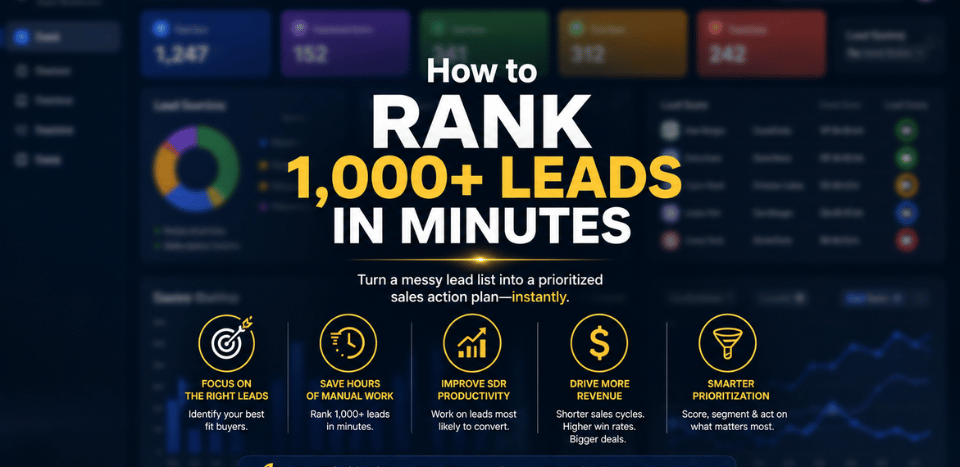
Most B2B founders do not have a lead generation problem.
They have a lead prioritization problem.
Every week, startups collect leads from:
website forms
webinars
LinkedIn outreach
paid campaigns
referrals
events
outbound sequences
The CRM keeps filling up.
The spreadsheet keeps growing.
The SDR team stays busy.
But revenue still feels unpredictable.
Why?
Because most teams have no structured system for deciding which leads actually deserve sales attention first.
As a result:
high-intent buyers wait too long
SDRs waste time on poor-fit accounts
founders get pulled into random follow-ups
pipeline quality becomes inconsistent
revenue forecasting becomes unreliable
This is exactly why modern B2B sales teams need a smarter way to rank leads quickly and systematically.
Not every lead deserves the same energy.
And the companies that understand this early build faster, more scalable revenue engines.
Why Most Lead Lists Become Operational Chaos
At first, a growing lead list feels exciting.
A founder sees:
1,000 webinar attendees
500 inbound inquiries
300 LinkedIn responses
dozens of demo requests
It looks like momentum.
But without prioritization, large lead lists become dangerous.
Why?
Because every lead starts competing for the same limited sales attention.
Most SMB sales teams still rely on outdated workflows:
first come, first served
SDR intuition
manual sorting
random CRM filtering
“follow up with everyone”
This creates a hidden operational problem.
The SDR team spends hours speaking with:
low-fit buyers
students
researchers
tiny companies outside ICP
non-buying personas
leads with weak urgency
Meanwhile, the real opportunities quietly go cold.
This is where sales productivity starts collapsing.
The issue is not effort.
The issue is focus.
Why Traditional CRM Filters Are Not Enough
Most CRMs can filter leads.
That does not mean they can prioritize revenue.
A CRM might tell you:
who opened an email
who visited a page
who filled out a form
But it often cannot explain:
which personas convert best
which industries close faster
which leads deserve founder attention
which company sizes generate larger deals
which lead sources produce higher win rates
which buyers are likely to move quickly
This is the difference between activity tracking and sales intelligence.
Modern lead ranking requires deeper context.
For example:
A VP Sales from a 300-person SaaS company attending a pricing webinar may deserve immediate outreach.
Meanwhile, a student downloading three PDFs may deserve zero sales effort.
Without structured prioritization, both leads often end up inside the same SDR queue.
That destroys efficiency.
The Smart Way to Rank 1,000+ Leads
High-performing B2B sales teams rank leads using layered prioritization models.
Instead of treating every lead equally, they evaluate:
ICP fit
buyer persona quality
company size
industry alignment
lead source
sales urgency
historical conversion patterns
qualification signals
potential deal value
This creates a much clearer sales hierarchy.
Instead of a flat lead list, the team sees:
Sales Now
SDR Qualify
Nurture
Suppress
Immediately, the pipeline becomes easier to manage.
The SDR team no longer wastes time guessing.
They know:
who deserves immediate outreach
who requires qualification
who should enter nurture
who should be ignored entirely
This dramatically improves outbound efficiency.
How Historical Sales Data Changes Everything
One of the biggest mistakes founders make is ignoring their own historical sales patterns.
Your past wins already contain valuable intelligence.
Inside historical sales data, you can identify:
which personas buy fastest
which industries convert best
which lead sources generate strong intent
which company sizes produce larger contracts
which segments create long sales cycles
which buyers repeatedly waste SDR effort
This changes lead prioritization completely.
For example:
A founder may assume all inbound demo requests deserve equal attention.
But historical analysis may reveal:
webinar leads convert 3x higher
healthcare closes faster
VP-level buyers produce larger contracts
startups below 10 employees rarely close
That insight allows the sales team to rank leads intelligently instead of emotionally.
This is where modern sales intelligence platforms create real value.
The goal is not simply scoring leads.
The goal is helping sales teams focus energy where revenue probability is highest.
Why Speed Matters in Lead Ranking
Lead ranking is not just about organization.
It directly impacts revenue timing.
The faster a team identifies high-quality opportunities, the faster they can:
respond
qualify
book meetings
move pipeline
close revenue
If a high-intent lead waits several days for relevant outreach, momentum disappears.
Meanwhile, many SDR teams still spend hours manually sorting spreadsheets before taking action.
That delay becomes expensive.
The companies winning today are building systems that prioritize leads in near real time.
This allows:
faster SDR response
better personalization
cleaner qualification
shorter sales cycles
stronger conversion rates
Ultimately, lead ranking becomes a competitive advantage.
The Future of Lead Management Is Revenue Prioritization
The future of sales is not about generating infinite leads.
It is about identifying:
which leads matter most
why they matter
what sales should do next
This requires combining:
ICP intelligence
SDR qualification
historical learning
workflow prioritization
AI-assisted outreach
When these systems work together, founders gain clarity.
Sales teams become more focused.
SDRs stop chasing random accounts.
And pipeline quality improves significantly.
The real goal is not to create more activity.
The goal is to create more meaningful sales attention around the opportunities most likely to generate revenue.
That is how modern B2B companies rank 1,000+ leads in minutes without overwhelming their sales teams.
Want to see how your team can rank 1,000+ leads in minutes without overwhelming SDR workflows?
Book a GroSales Intelligence demo and discover how to prioritize high-intent buyers, reduce wasted sales effort, and build a cleaner sales pipeline.
Your Sales Growth Partner
Contact US
Subscribe
sales@salesnair.com
India:
© 2026. All rights reserved.
GroRev SalesNair


GroRev SalesNair LLP (USA)
10685-B Hazelhurst Dr. # 43483, Houston, TX 77043, USA


Accepted payment Methods
GSTIN: 06ABBFG6113A1Z5
LLP Identification Number: ACI-7240
Policies
GroRev SalesNair LLP (INDIA)
B6-701, KLJ Greens,
Sector -77, Faridabad
Haryana -121004
USA:
GroRev SalesNair LLP (INDIA)
IDEASHACKS, Metro Pillar Number 564, 14/3, Mathura Rd, Sector 31, Faridabad, Haryana 121003