
How to Extract the Founder’s Sales Knowledge into an Actionable Playbook
How to run a pipeline velocity audit, build a persona pain-prioritization matrix, and turn personal intuition into an empirical corporate asset.
In the early days of a B2B technology startup, sales are driven by raw, unadulterated founder intuition. As a founder, you possess an unfair advantage: you built the platform, you know every line of its architecture, and you can instinctively read a prospect’s expressions to pivot your pitch in real-time. You know exactly when an incoming lead is a waste of time, which specific personas experience the sharpest operational pain, and how to position your value proposition to crush legacy competition.
This intuitive approach works beautifully to get your first ten customers. But as you prepare to scale, this intuition transforms into your greatest risk.
If all the sales logic, customer insights, and qualification rules live exclusively inside your head, the business cannot grow without your constant, physical presence. To scale your revenue engine, you must turn your personal sales genius into an institutional asset that the business owns. This process is not about drafting a generic document; it is about moving your startup from emotional, gut-feeling sales to an empirical, data-driven revenue framework.
Here is the exact tactical blueprint to extract your personal sales insights and build an actionable, scalable playbook.
Pillar 1: The Pipeline Velocity Audit
The first step in extracting your brain is to replace your subjective assessment of "who is a good customer" with hard, empirical evidence. Early-stage founders frequently suffer from confirmation bias—remembering the one large enterprise deal that closed after six months while ignoring the smaller, high-velocity deals that actually sustain the cash flow.
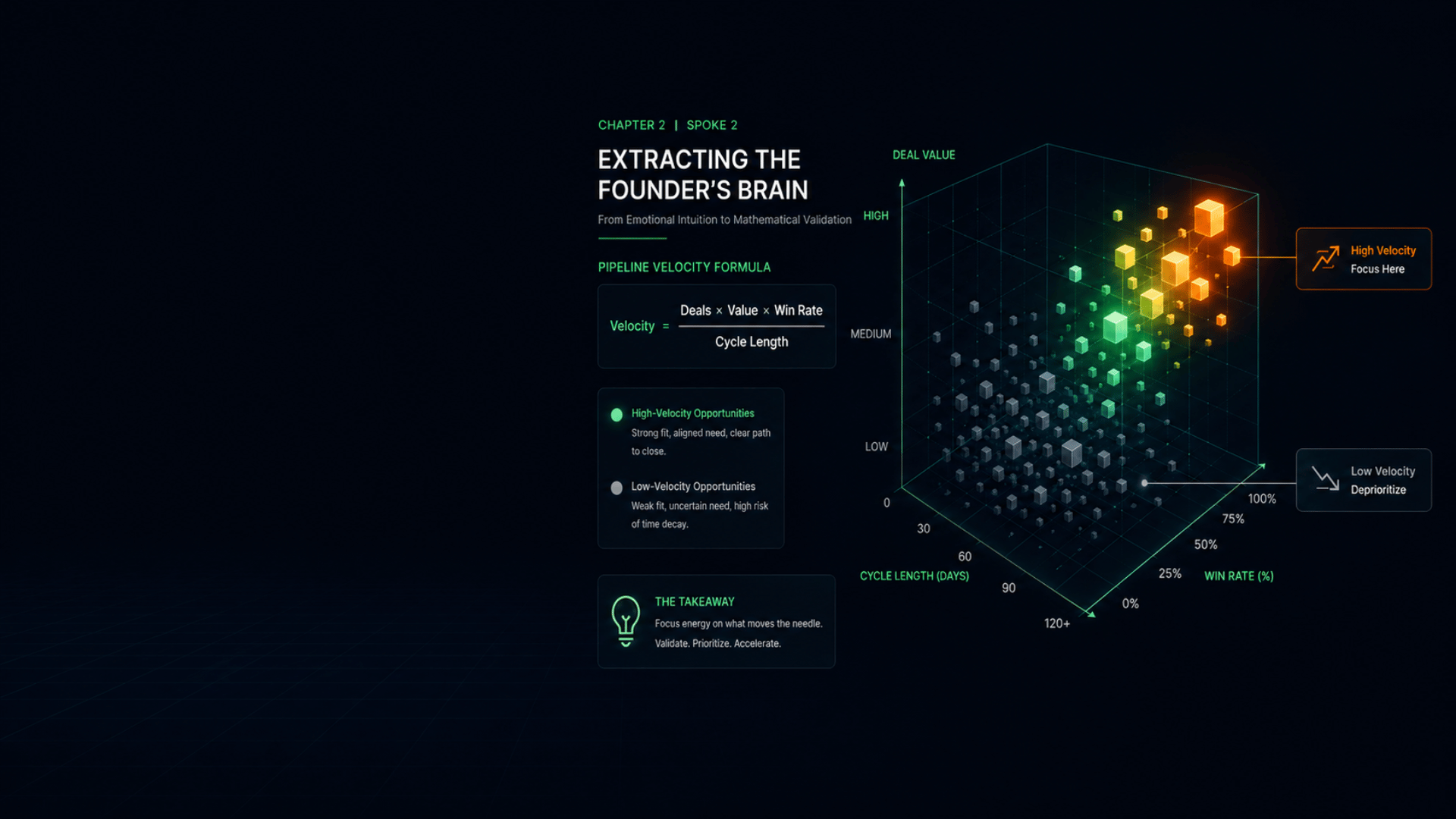
To find your true Ideal Customer Profile (ICP), you must look at your historical sales data through the lens of pipeline velocity. The goal is to identify which customer segments move from initial touchpoint to closed-won with the absolute least amount of friction.
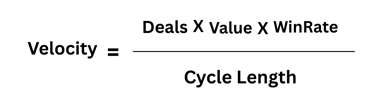
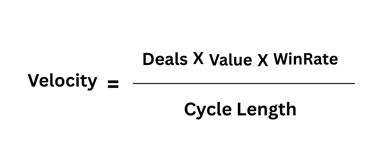
We isolate this by breaking your past closed deals into cohorts based on industry vertical, company size, and specific buyer personas, and then tracking their movement using the pipeline velocity formula:
When you run this audit across your past wins, the data will often surprise you. You might find that while mid-market logistics companies yield lower contract values than global manufacturing conglomerates, their win rate is three times higher, and their sales cycle length is a quarter of the time. This data-driven realization provides absolute validation for your core market strategy. It strips the emotion away from your targeting criteria and isolates the exact segments where your product has an indisputable right to win.
Pillar 2: The Pain-Prioritization Matrix
Once you have identified your highest-velocity customer segments, you must extract the psychological triggers that cause them to buy. Most startup playbooks fail because they focus heavily on demographic data—listing target revenues, employee counts, and geographic locations.
But companies do not buy software; people buy software to solve acute corporate pain.
Your playbook must map out a precise pain-prioritization matrix for each validated persona. You need to document the exact business friction your buyers face daily and categorize those pains by their severity:
Critical Pains (Immediate Intervention Required): The operational bottlenecks that are costing the prospect significant revenue, creating regulatory compliance risks, or threatening their job security. These are the problems that force a budget holder to sign a contract immediately.
Latent Pains (Nurture Necessary): Inefficiencies that the prospect is aware of but has learned to live with through manual workarounds.
By documenting exactly how your product maps to these critical pain points, you pull your personal positioning framework out of your head. You define the exact boundaries of a highly qualified lead based on the severity of their business problem, rather than the size of their balance sheet.
Pillar 3: Differentiated Positioning Architecture
The final component of extracting your brain is capturing your competitive positioning. In early sales conversations, when a prospect asks, "Why should I choose you over an established legacy provider?" your answer is swift and convincing. You know your product’s unique edge.
To make this knowledge scalable, you must formalize your differentiated positioning architecture. This means documenting your value metrics in a clear, unassailable format.
Do not focus on basic feature comparisons. Instead, document your value propositions based on the outcomes you deliver that competitors cannot replicate. Outline the exact tactical objections you hear most frequently and match them with your verified customer onboarding insights. Document the path of least resistance—the exact workflow changes, implementation timelines, and quick-win scenarios that make choosing your startup a low-friction decision for a risk-averse corporate buyer.
Turning Extraction into Infrastructure
Extracting your sales knowledge creates the strategic content your startup needs to thrive. It ensures that your unique positioning, validated target market segments, and core persona insights are safely out of your head and codified into a repeatable corporate framework.
However, a playbook is only as valuable as its execution. Once you have successfully mapped out your data-driven ICP, prioritized your persona pains, and locked down your positioning architecture, you must transform these concepts into automated workflows. The strategic rules you have extracted must be embedded directly into your operational technology stack, allowing your system to automatically filter, prioritize, and route leads based on your verified criteria.
📌 Next Step in the Architecture
Now that you have codified your positioning and mathematically validated your Ideal Customer Profile, how do you inject these exact rules into your daily workflow? Read the technology breakdown: Moving Beyond Founder-Led Sales: Infrastructure vs. Headcount
Your Sales Growth Partner
Contact US
Subscribe
sales@salesnair.com
India:
© 2026. All rights reserved.
GroRev SalesNair


GroRev SalesNair LLP (USA)
10685-B Hazelhurst Dr. # 43483, Houston, TX 77043, USA


Accepted payment Methods
GSTIN: 06ABBFG6113A1Z5
LLP Identification Number: ACI-7240
Policies
GroRev SalesNair LLP (INDIA)
B6-701, KLJ Greens,
Sector -77, Faridabad
Haryana -121004
USA:
GroRev SalesNair LLP (INDIA)
IDEASHACKS, Metro Pillar Number 564, 14/3, Mathura Rd, Sector 31, Faridabad, Haryana 121003