
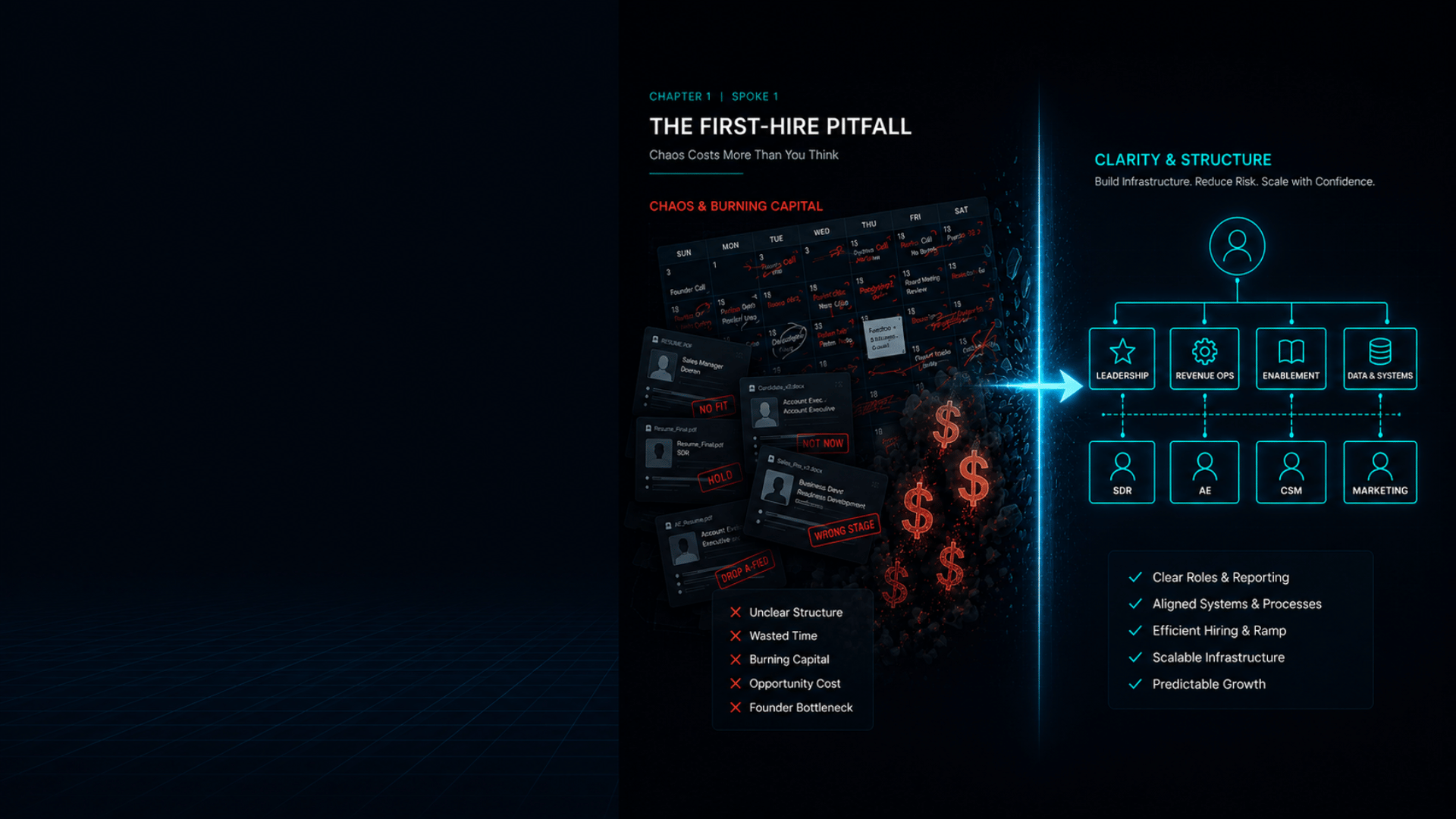
Why 70% of First Sales Hires Fail
(And How to De-Risk Your Hire)
Why premature headcount scaling burns startup runway, and how to build the operational guardrails that guarantee rep success from day one.
For an early-stage startup founder, hitting the limits of founder-led sales is a milestone worth celebrating. It means your product has found initial market validation, your messaging has resonated with early adopters, and revenue is coming in.
However, this milestone quickly brings a crushing operational bottleneck.
Between managing product roadmaps, handling customer success, and running every single sales demo, your calendar is completely maxed out. When this time crunch hits, the instinctive reaction is to look for relief through recruitment. The standard playbook says it is time to go to market and hire an experienced Sales Development Representative (SDR) or a seasoned enterprise Account Executive (AE) to take over the pipeline.
You find a candidate with an impressive corporate history, past quotas beaten, and hand over the keys to your sales process with a simple expectation: “This person is a sales professional. They will just figure it out the same way I did.”
Statistically, they won't.
Industry data consistently shows that nearly 70% of first sales hires at early-stage tech startups fail within the first six to nine months. This premature scaling attempt is one of the fastest ways to burn precious runway capital.
To protect your startup, you must understand why this failure occurs and how to engineer a system that de-risks your growth.
The Illusion of the "Rockstar" Sales Hire
When you close deals as a founder, you are operating with an unfair advantage that no resume can replicate. You possess a deep, instinctual understanding of the product’s architecture, an intimate knowledge of early customer pain points, and the unique authority of a creator. When a prospect raises a complex objection, you pivot seamlessly because the entire corporate vision lives in your head. You can make promises, adjust pricing on the fly, and project a level of passion that a hired employee simply cannot match.
A new sales hire, no matter how talented, has none of these advantages on day one.
When you inject a sales rep into an organization that lacks an established revenue architecture, you are dropping them into a dark room without a flashlight. They do not know your true value proposition, they do not know which specific features map to which customer pain points, and they do not have a validated map of the market.
Instead of executing a repeatable strategy, the new hire is forced to guess. They guess which titles to target on LinkedIn, they guess which industry verticals are showing buying signals, and they guess how to pitch your product based on what worked at their previous, entirely different company. They spend months chasing unqualifiable leads, mistaking activity for progress, while your capital burns away.
The Hidden Costs of Cold-Start Attrition
Hiring headcount before establishing infrastructure does not just waste the salary of the representative; it introduces massive hidden liabilities to your startup:
Burned Market Reputation: When unguided sales reps conduct outbound prospecting using unvalidated messaging, they burn through your finite target market. A bad email sequence or an uncoordinated cold call can permanently close the door on high-value enterprise accounts before your startup even gets a chance to mature.
Founder Distraction: Instead of freeing up your time, an unstructured hire actually consumes more of it. You find yourself trapped in endless, ad-hoc training sessions, manually reviewing their outbound emails, and jumping on calls to save deals that are going sideways because the rep lacks operational guardrails.
Data Corruption in CRM: Without strict rules, a new rep will clutter your CRM with unverified contacts, poorly categorized leads, and inaccurate pipeline stages. This makes it impossible to extract meaningful sales velocity metrics later on.
By the time you realize the hire is not working out—usually around the 90 or 180-day mark—your startup has burned millions of rupees, lost critical market momentum, and is right back where it started: dependent entirely on founder-led sales.
How to De-Risk Your Next Sales Hire
To scale past founder-led sales without burning capital, you must shift your mindset from hiring headcount to building infrastructure. In a mature B2B sales organization, the system drives the person, not the other way around.
Before you post a single job description, you must establish three core operational guardrails to de-risk the role:
1. Extract the "Founder's Brain" into a System
You must pull the sales logic out of your head and embed it into a repeatable workflow. Do not expect a rep to guess your positioning. Document your differentiated value proposition, prioritize core customer pains based on specific personas, and outline your lowest-friction customer onboarding insights. This ensures your institutional knowledge becomes an asset the business owns.
2. Move from Gut-Feeling to Data-Driven ICPs
You cannot expect a sales rep to find your ideal customer if you cannot define them mathematically. Use your historic sales data to clearly outline your true Ideal Customer Profile (ICP). Your team must know exactly which company size, geographic region, technology stack, and job title closes with the highest pipeline velocity. This removes emotion from prospecting and provides absolute validation for the incoming rep.
For a step-by-step breakdown on extracting this data from your past wins, see our tactical guide on how to extract founder sales knowledge into an actionable playbook.
3. Implement Algorithmic Lead Prioritization
Reps should never spend their morning staring at a blank CRM screen trying to decide who to call. Your sales infrastructure must automatically score and label leads into clear operational buckets inside your CRM (like HubSpot or Salesforce).
By filtering leads into categories like Sales Now (high-intent, high-fit), SDR Qualify (target accounts needing outreach), or Suppress (bad-fit data), your reps do not have to think about data accuracy. They can focus 100% of their energy on high-value activities: building relationships and booking meetings.
Automating this workflow inside your CRM removes data fatigue from your onboarding process entirely. To see the exact technology stack required to run this engine, read our breakdown on moving beyond founder-led sales infrastructure.
Build the Infrastructure First
Hiring a sales team before you have a predictable process is a gamble where the house always wins. If you want your first sales hire to succeed, give them an engineered environment where failure is structurally difficult.
By building your data-driven ICP, establishing clear lead scoring workflows, and aligning your value proposition first, you stop buying expensive headcount risks. Instead, you build a predictable revenue engine that scales your startup seamlessly beyond founder-led sales.
Your Sales Growth Partner
Contact US
Subscribe
sales@salesnair.com
India:
© 2026. All rights reserved.
GroRev SalesNair

GroRev SalesNair LLP (USA)
10685-B Hazelhurst Dr. # 43483, Houston, TX 77043, USA


Accepted payment Methods
GSTIN: 06ABBFG6113A1Z5
LLP Identification Number: ACI-7240
Policies
GroRev SalesNair LLP (INDIA)
B6-701, KLJ Greens,
Sector -77, Faridabad
Haryana -121004
USA:
GroRev SalesNair LLP (INDIA)
IDEASHACKS, Metro Pillar Number 564, 14/3, Mathura Rd, Sector 31, Faridabad, Haryana 121003