
From Spreadsheet to Sales Queue: How to Rank 1,000+ Leads in Minutes
Stop the "Spreadsheet Trap" and rank lead lists in minutes. Learn how GroRev SalesNair uses AI lead scoring for startups to turn raw data into a prioritized sales queue of high-intent prospects.
SALES MASTERY
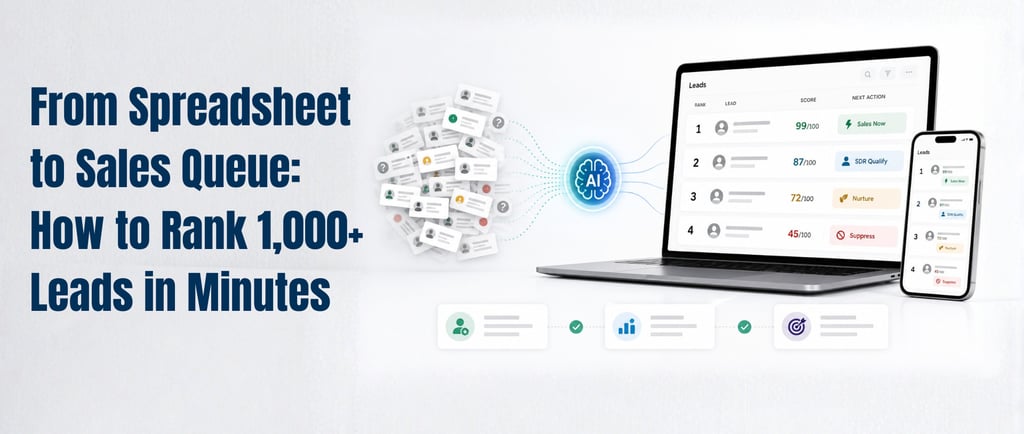
The Spreadsheet Trap: Why "More Leads" Often Means Less Revenue
Every B2B founder has lived this moment. You export a fresh batch of leads from LinkedIn, download an attendee list from a recent webinar, or watch a flurry of website form fills hit your inbox. Suddenly, you are staring at a spreadsheet with 1,000+ rows.
At first, it feels like progress. You assume more leads must lead to more revenue. But within forty-eight hours, reality sets in. You don’t know where to start, every row looks equally important, and the sheer volume becomes a wall.
What do most lean sales teams do? They default to randomness. They pick leads based on gut feeling, recency, or whoever replied to an old thread last. This is the "Spreadsheet Trap." High-intent prospects who are ready to buy get ignored while low-fit leads consume hours of your team's energy. Your pipeline looks active, but your conversions remain unpredictable because your data does not guide action.
Why Static Lead Lists Stagnate
To escape this, you must move beyond managing a database and start engineering decision-making. Static lists fail for three reasons:
A Lack of Prioritization: Spreadsheets are flat by design. Without a B2B lead prioritization tool, there is no inherent intelligence telling you who to contact right now.
Information Overload: Similarity does not equal intent. Two companies can look identical on paper, but one is actively searching for a solution while the other doesn't even recognize the problem yet.
Manual Fatigue: Manually triaging 1,000 leads is not a scalable strategy. By the time you finish "cleaning" the list, your outreach quality has already dropped.
The Architect’s Fix: How to Rank Lead Lists for Performance
The shift from chaos to a high-performance sales queue requires an intelligence layer that contextualizes your data. For GroRev SalesNair clients, this transformation happens in three strategic phases:
1. Import and Enrich
Upload your raw data—LinkedIn exports, event lists, or scraped databases. Instead of just "cleaning" the text, use AI lead scoring for startups to analyze your historical wins and losses. The engine identifies patterns in personas, industries, and trigger signals that actually correlate with your revenue outcomes.
2. Automatic Categorization into Action Buckets
This is where your list becomes a true sales queue. Every lead is automatically sorted into operational buckets:
Sales Now: High-fit, high-intent prospects who deserve immediate, personalized outreach.
SDR Qualify: ICP-aligned leads that require discovery and warming up.
Nurture: Long-term opportunities that are a good fit but aren't ready to buy today.
Suppress: The "Red Flag" leads. By intentionally ignoring low-fit prospects, you protect your team’s most valuable asset: their time.
3. Execute with Explainable AI
Most tools fail because they are "black boxes." They give you a score but no reasoning. Professional sales intelligence for SMBs focuses on transparency. For every lead, you should see exactly why it was ranked high, which signals influenced the score, and how it compares to your past winning deals. This bridges the gap between automation and human judgment.
Building Your Revenue Engine
When you implement a system to rank lead lists automatically, you stop being a lead manager and start being a Revenue Architect. You spend more time selling and less time analyzing. Your pipeline becomes cleaner, your forecasts become reliable, and your conversion rates begin to climb.
For startups and SMBs, you do not have the luxury of endless budgets. Every conversation matters. By leveraging AI lead scoring for startups, you ensure that every action your team takes is aligned with a predictable outcome.
Your Sales Growth Partner
Contact US
Subscribe
sales@salesnair.com
India:
© 2026. All rights reserved.
GroRev SalesNair


GroRev SalesNair LLP (USA)
10685-B Hazelhurst Dr. # 43483, Houston, TX 77043, USA


Accepted payment Methods
GSTIN: 06ABBFG6113A1Z5
LLP Identification Number: ACI-7240
Policies
GroRev SalesNair LLP (INDIA)
B6-701, KLJ Greens,
Sector -77, Faridabad
Haryana -121004